
I Wanna Be Punk Rock
Oh my God! I'm confused!
I want to go punk, but there's way too many rules
— Guttermouth, "Baker's Dozen"
Mark,
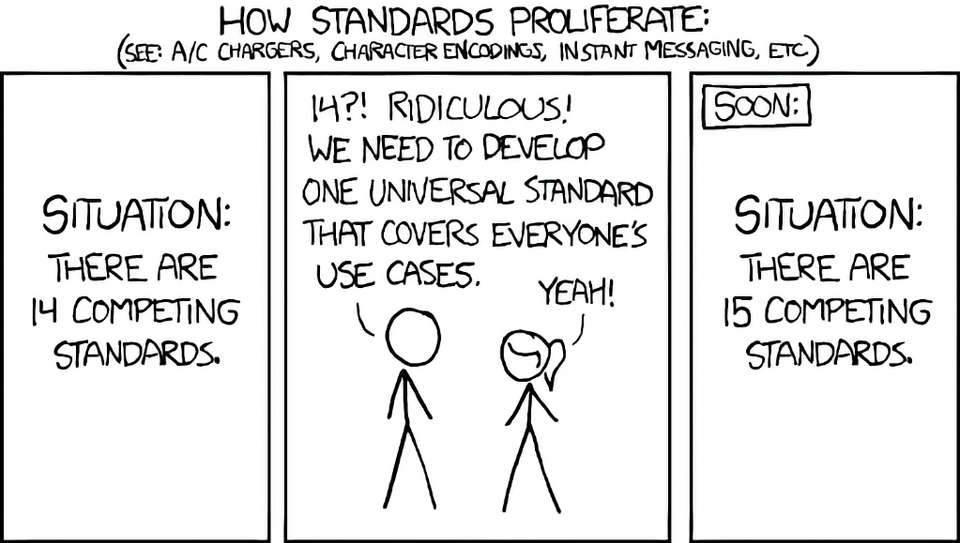
Have you seen XKCD 927?
That's not a joke. That's a law of nature. Every time you remove structure, the vacuum fills itself with a Baker's Dozen of worse options.
The Decay
Here's the pattern. I've watched it play out in open source, in corporate tech, in agile, in punk. Same four steps every time.
Remove structure. Someone looks at the hierarchy and says this isn't working. Too rigid, too slow, too much power in the wrong hands. They tear it down. Good intentions. Real problems being solved. But they don't replace it — nature abhors a vacuum.
Competing structures emerge. Friend groups, cliques, people with pre-existing relationships — they start filling the gap. Usually innocently. Decisions need to be made and they're the ones who already talk to each other. The structure reasserts itself, just without transparency or accountability.
Performative behavior. People start projecting identities they think the structure should have — onto themselves, and others. Roles nobody assigned harden into expectations and gain undelegated authority.
Gatekeeping. "In order to protect the system." Which really means: in order to protect the invisible structure that maintains the undelegated but assumed powers. Anyone who violates the power structure is accused of being against the goals of the group. Gatekeeping always wears the mask of principle.
Free Software, Open Source, Source Available
I've lived this in open source for most of my career.
The timeline is messy — the licenses and communities overlapped — but the broad strokes hold. Free Software started with a principle: software should be free. Free as in speech — the right to run, study, modify, and share. No structure, no gatekeepers, just people sharing code because they wanted to build something communally.
The same people who wanted to build communally wanted to include their work lives too. Communal building didn't fit the model of business at the time. So Open Source emerged — and thrived because it solved real problems that the Software Freedoms couldn't. It traded some principles for pragmatism.
Business models changed, but capitalism didn't. The relationships became extractive — companies making billions and contributing as little as possible back. Source Available has emerged as a way of solving the sustainability problem of shared commons being extracted for private use without fair compensation. Pragmatism subverted the principles further — no structures existed to combat the economic extraction.
Each split was real. Each solved a genuine problem the previous structure couldn't. And each one traded something essential for something necessary. Where communities built strong foundations — explicit structure, accountable governance — the commons survived. Where they didn't, the commons didn't survive.
GPL, AGPL, MIT, BSD, Apache, MPL, Artistic, BSL, SSPL, Elastic License, Commons Clause, etc. Fourteen competing standards.
Valve's Wheels
The voluntary nature of open source makes it easy to explain away: "People aren't getting paid, of course it falls apart." Valve proved that wrong.
Valve was a meritocracy. No managers. No hierarchy. Flat structure, but corporate design. Desks even had wheels so you could roll to whatever project you preferred. Work on what you want, we're all adults here.
The reality: cliques formed. Influential people got headcount for their projects and became the real power structure — invisible and unaccountable. "Merit" got defined by the people already in power. Only the visible, flashy projects attracted people because that's where promotions and bonuses happened. The necessary but unglamorous work stayed invisible. Autonomy was a performative layer over an invisible approval process. This same invisible structure ran performance reviews, where who you knew mattered more than what you built. The invisible hierarchy protected itself with threats about your "culture fit."
Paychecks didn't fix things. Money made it worse. The pattern is structural, not economic.
Jo Freeman Wrote It Down First
In 1970, Jo Freeman watched this happen in feminist consciousness-raising groups. Groups that explicitly rejected hierarchy and formal structure. She wrote "The Tyranny of Structurelessness" — and she documented the exact same decay.
Friendship groups became the real decision-making bodies. People with pre-existing social bonds held invisible power. Members performed structurelessness — "we're all equal here" — while decisions were made in private conversations. Anyone who named the power structure was accused of being against the group.
Freeman's conclusion: the absence of formal structure doesn't mean the absence of structure. It means the structure is hidden, and hidden structure can't be held accountable.
She was documenting the 1960s. Three generations later, we're still repeating the pattern.
Agile's Baker's Dozen
Skacore, snowcore, hardcore, homocore, albacore
I can't take it anymore!
The subcategories started before the Manifesto. Scrum predates it by a decade. XP was already in practice. The Agile Manifesto was in its own way standard number fifteen — an attempt to unify what was already fragmenting.
Individuals and interactions over processes and tools. Working software over comprehensive documentation. Customer collaboration over contract negotiation. Responding to change over following a plan.
SAFe is the Source Available license of agile frameworks. It performs as if it holds to the ideals, but they're safely tucked away so that the company doesn't need to change its power structures.
The certifications, the conferences, the Hot Topic Scrum Masters add to the performative behavior and gatekeeping. CSM, CSPO, PMI-ACP, SAFe Agilist, ICAgile. Skacore, snowcore, hardcore, homocore, albacore.
Each iteration more fractured. Each trading ideals for pragmatic solutions.
Should I be emo and just cry?
Maybe I'll go skacore and skank until I die?
How about hardcore? Really hardcore
I fucking hate that metal shit
Sober vegans you all suck!
So what's your core? Stupid whore!
The gatekeeping: "That's not real agile." "Scrum is a framework, not a methodology." "If you're doing SAFe you're not doing agile." The invisible power structures of each smaller group protecting itself against inconvenient questions that might tear it down as well. That's not meritocracy. That's the tyranny of structurelessness Jo Freeman documented in the 1960s. And it's eating the FOSS community.
We just need a fifteenth agile framework to cover all of the other use cases, right?
What Structure Actually Looks Like
I keep coming back to 924 Gilman. I wrote about it in "A Dark and Isolated Planetoid" — the punk venue that's survived for forty years. No corporate sponsors. No major labels. Volunteer-run. But not structureless — Tim Yohannan and the MaximumRocknRoll crew set up a volunteer board from day one. Elected. Accountable. Visible. They wrote the rules — no violence, no racism, no sexism, no homophobia, all-ages — but more importantly they built the structure that enforced them.
The rules aren't the structure. The enforcement is. Anyone can write principles on a wall. The question is who has the authority to hold people to them, and whether that authority is transparent and legitimate.
You don't need hierarchy. You need structure. 924 Gilman didn't have a boss. It had a board you could see, challenge, and vote out. That's what kept the invisible power structures from forming. Not the absence of authority — the presence of accountable authority.
Robert Peel, founder of London's Metropolitan Police, said "the police are the public and the public are the police." The enforcers aren't separate from the community — they are the community. That's 924 Gilman's board. Every invisible hierarchy that assumes undelegated power does so without consent by definition.
I wanna be unusual
I wanna be punk rock
I wanna be unusual
Punk at its best is unusual — not because it's ungovernable, but because the governance arises from the autonomous consent of the community. I wanna be unusual. I wanna be punk rock.


Member discussion